Decisions and principles
Folder section to write internal and external decisions and principles. Also other aspects in software development.
Decisions
Microservices and API-s
All external or third party API-s by default should be behind internal API.
- actually can be more fault-tolerant
- more freedom (caching, DB, replace, re-desing external API or design, replace [later throw external out]).
- 2 types, that can be in one but clearly understandable, what can be used ** direct, that is 1:1 transferring and translating 3dp or external API ** complex or translated (strongly preferred), that is probably translating and doing many complex requests to 3dp/ex API
Translations
Should be:
- used as one or in many formats (JSON, XML, JS, Java properties, YAML, ...), that can be requested for example with GET method
- added at compile time
- added, loaded or used at runtime (REST or other API), and probavly cached for runtime
- in DB
- versioned (versions can be 1:1 withh software version os independent)
- by application, module or API
- use camel case JS format as key ("someApplicationView.tooltip")
- with user UI
Developers
Preferred OS should be chosen for production machines, and developers should use that OS as a development machine.
- learning and collecting know-how
IDE - same IDE without configuration changes for all developers
That means:
- install
- start working
Instead:
- install
- remember to find documentation
- read documentation
- configure by documentation
- start working
IDE
- IntelliJ (Java + others)
- PyCharm (Python)
- CLion (C/C++)
- NetBeans (Java, C/C++)
Docker
Images should based on developers maschines.
    - transferrign knowhow into Dockerfile. No differences and different thinking from developer machines.

Organization should have its own Docker image hierarchy, consolitating security and knowhow in different hierarchy nodes by needs.
Linux
In priority order (higher to lower): Rocky, Fedora linux, CentOS, Debian
Follow FHS: https://refspecs.linuxfoundation.org/FHS_3.0/fhs/index.html
Follow LSB: https://refspecs.linuxfoundation.org/lsb.shtml
By setmy.info standards, all packages should be unpacked (if possible) directly under /opt folder.
Examples:
- /opt/cmake-3.17.1-Linux-x86_64
- /opt/jdk-14.0.1
- /opt/firefox
- /opt/node-v12.18.1-linux-x64
- /opt/apache-maven-3.6.3
Other OS
In priority order (higher to lower): FreeBSD and OpenIndiana.
Containers
In priority order (higher to lower): Docker, Jail and Zone.
Tools: Docker registry, Kubernetes for Docker. Probably should change, becase of RedHat new tools. Need to analyze these.
    (RancherOS, Helm ?)
Front end
- Angular
- LESS
- Single-Page application
- PWA
- Responsive web design
- Cross-browser
- IE11 (minimum IE)
- Jasmine FW
- Karma
- 3 Layer (Controller/controlling, Service, Resource/API)
- Service layer independent of Frameworks (VueJS, Angular, React etc.), dependent on Axios (browsers’ support fetch).
Browser market share: https://gs.statcounter.com/browser-market-share
Back end
- Standard language set
- Java, Groovy, Clojure, Python, C/C++, Elixir
- SpringBoot, Spring
- JSR-330
- 3 Layer (Controller/REST/SOAP/etc., Service, DAO/API/DataSource)
- JPA (Hibernate)
- Log4j2
3 modules (Application, implementation (services), models (also interfaces, exceptions, VO, DTO-s))
Testing
- JUnit 5
- AssertJ
- Mockito
- Java + Selenium (hub and nodes)
- Cucumber
Test farm has to be built.
Smart devices and PC:
- iOS devices
- Android devices
- Sony
- Samsung
- Nokia
- Windows devices
Resolutions
-
https://allcolorscreen.com/my-screen-resolution
- Xiaomi Redmi Note 14 Pro+
- FF: 508 x 1130 (DPR device pixel ratio: 2.40)
- Chrome: 407 x 904 (DPR: 3.0)
- Nokia G20
- FF: 408 x 907
- Chrome: 412 x 915
- Sony Xperia 10 I4113 https://www.gsmarena.com/sony_xperia_10-9353.php
- FF: 360 x 840 ()
- Chrome: 360 x 840 (3:7)
DB
- H2
- PostgreSQL/Postgis
- Tools: Liquibase
- MongoDB
- DGraph/Neo4J
- Lucene
Layers responsibility
- Filters and exception handlers
- 1.1 Should do security checks, if possible and meaningful to do these here
- 1.2 Error messages transformation to HTTP error codes and messages with data: translation key (no error code), additional data
- App/Controller/Resource/Scheduler
- 2.1 Do security checks with calling security related service(s) before entering any (business) logic
- 2.2 Data transformations for calling (business) logic services. For example, DTOs to other class model data. Data mapper, transform or other services have to be called.
- 2.2 Logic service calls.
- 2.3 Ordinary exceptions to web exception transformation for error message transformations (1.2)
- API/Service
- 3.1 Security check services
- 3.2 Data validation check services
- 3.3 Data transformation services
- 3.4 Logic services, data request and population services
- 3.5 Has its own data models and therefore…
- 3.6 Is independent of point 2 layer
- DAO/Repository/API
- 4.1 Request objects from DB or from external API-s
Decided tools, components and libraries
OS
1.1 DOCUMENTATION MOVED
Containers
2.1 DOCUMENTATION MOVED
2.2 DOCUMENTATION MOVED
3 Shell
3.1 Bourne shell and use #!/bin/sh not #!/bin/bash. The First one is in base installation of CentOS, Fedora, BSD, Solaris, Debian (buntu), OpenIndiana etc.
3.2 Therefore a shell script should be not written in “bashism” (bash way), but as much as possible in POSIX shell way.
3.3 Prefer shell first and if not possible or simpler, then Python 3.x.
UI
4.1 because HTML has no rich standard set of components, then we need write components by our selves.
4.2 IE 11 is still in use, therefore, that should be covered too.
4.3 Prefer CSS tool over JS tools to get UI results.
4.4 because of http2 push method we use old style resources (css, js) loading. Possible to make (if it is not already done) tag library, that does push first for JSP or HTML loading.
4.5 Therefore and because of webpack we should support in JavaScript node packaging and
Logs
5.1 Logging should go to tailable file.
5.2 Logging should be with size limit; that means logs should be split after reaching the limit.
6 Build tools
6.1 For Java maven
6.2 Other build tools and helpers: cmake, ant, make (GNU?)
6.3 Webpack build tool for frontend tools.
6.4 Reporting building with maven using maven site, where site has integrated reports: JavaDoc (for main and test code), pitest, OWASP dependencies check, JaCoCo unit test coverage, style check, version notes, todo notes, findbugs.
JavaScript (JS)
7.1 Prefer ECMAScript 6 - “Pure JS”. Newer standards added a lot of other keywords and possibilities. Some of them make code reading harder!
7.2 Prefer Pure JS to TypeScript.
7.3 Prefer code without “prototype”. Just create an object and add properties.
7.4 Frontent JS
7.4.1 Use layered architecture: resources at bottom for data access and data fixing and normalization, service layer top on that for …
7.4.2 Prefer two-way data binding over event dispatch-catch.
Java
8.1. Prefer solutions to write code without interfaces. Interfaces are for frameworks or plugins, where N number of third parties should implement something.
8.2. Java fail length up to 512 lines and line length 110.
Clojure
- With Leiningen. To switch to .edn, prepare requirements by Leiningen setup and prepare .edn and verify.
Source Controll
9.1. GIT over Mercurial
Misc
- Hibernate
- DB: PostgreSQL, MongoDB, DGraph (?)
- MQ: RabbitMQ (should be used, when they hide problems? Replace it with Redis?), Mosquitto
- Spring, Spring boot andMicronaut, but using as much as possible standard way (javax.*).
- Semantic versioning: https://semver.org/
- Solution levels
- Only JWT check with symmetric keys. No session cancellation (JWT revoke). Fully stateless solutions. No central solutions cache for apps. Single node solutions. App backend as GW.
- DB JWT check with symmetric keys. DB-based session cancellation and expiration (JWT revoke). Single node solutions. App backend as GW. No central cache solutions for apps.
- DB JWT check with symmetric and asymmetric keys. DB-based session cancellation and expiration (JWT revoke). Multi node solutions. App backend as GW. No central cache solutions for apps.
- Central Cache and session storage. JWT and session revoke in cache systems. Multi node solutions. Multi HW servers only.
- Central Cache and session storage. JWT and session revoke in identity management systems. Multi node systems. Health checks. API GW (rate limiting, security, identity management, etc.). Multiple hardware (servers, network nodes, power supplies, UPS etc.) nodes. Storage systems.
- Prefer standard or well defined or stable tools over self making tools.
- Xfce is class desktop environment.
Application configuration
Overload (overwritten from top to down) order
| Order |
|---|
| Defaults in code |
| File (.yaml overwrites .properties) |
| Environment variables |
| CLI |
Variable naming convention
| Prefix | |
|---|---|
| File properties yaml |
smi. smi: |
| Environment variables | SMI_ |
| CLI | –smi- |
smi.xyz=abc,def,ghi
smi:
    xyz: abc,def,ghi
SMI_XYZ=abc,def,ghi
abx --smi-xyz=abc,def,ghi
Names after prefix:
| Configuration option | properties | yaml | Environment variables suffix | CLI options suffix | Notes |
|---|---|---|---|---|---|
| Profiles | - | - | PROFILES | -profiles | |
| Config paths | - | - | CONFIG_PATHS | -config-paths | |
| Optional application config files | - | - | OPTIONAL_CONFIG_FILES | -optional-config-files | |
| Application name | - | - | NAME | -name |
CI, Jenkins
Master should have stable and verified and re-releasable any moment code.
Merging means also software installation to some environment. Work merged to master means going automatically to live.
To develop merging is after successful code review by developer(s). Branch have to be merged fast, because most cases QA is bottleneck. If needed, release branch can be used for code freeze (for QA manual testing) - try to avoid and do in sprint/iteration testing and increase automatic testing.
To release and master merging is organizational (QA, developers, board, etc.) decision.
| Branch | Environment | Branch name | Artifacts published | Tag | Notes |
|---|---|---|---|---|---|
| feature | - | feature/xxxxxxxxxxxx | - | - | |
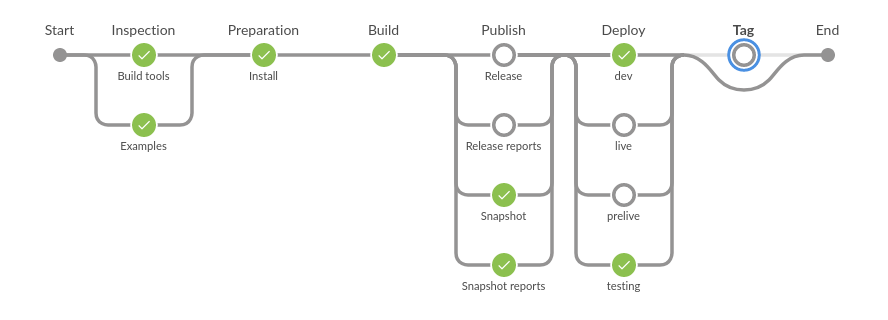
| develop | dev, test | develop | snapshot software and snapshot reports | - | Can go only to dev env, skip test deploy. |
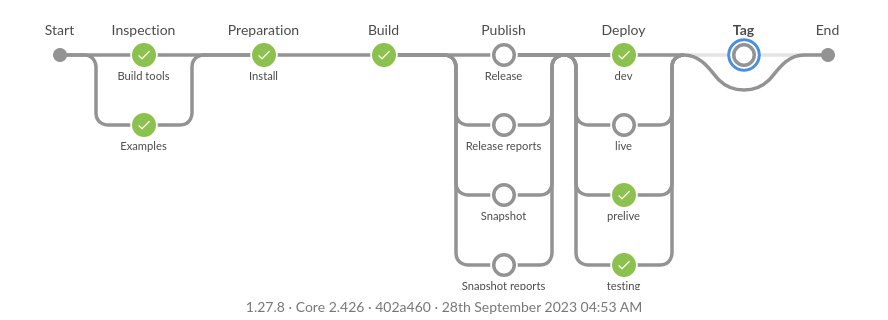
| release | dev, test, prelive | release/1.0.0 | - | - | Can skip dev env. deploy. |
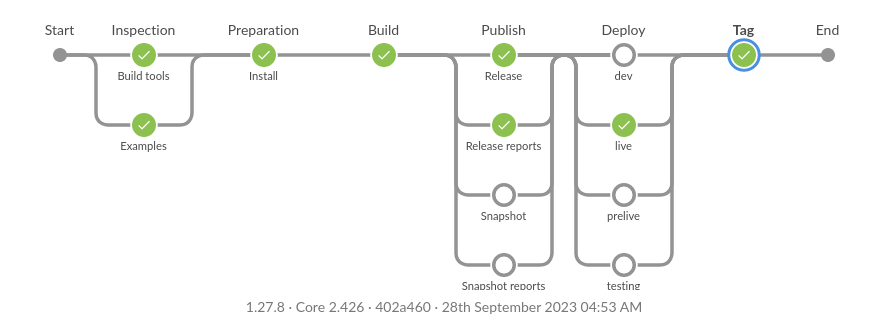
| master | live | master | release software and release reports | automatically created |
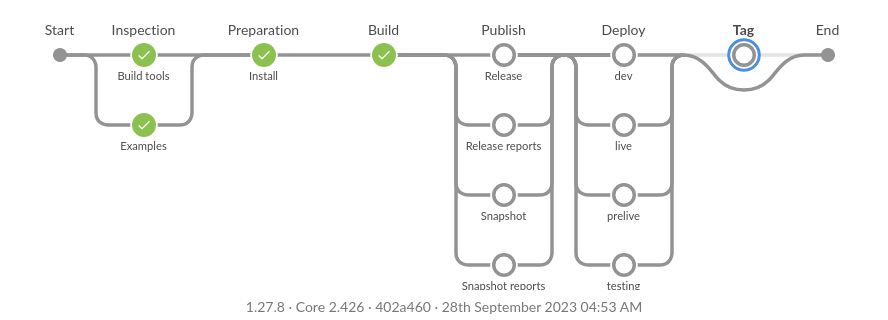
Stages
- Inspection verifies build environment requirements (OS, Java, node, npm versions, existence, …).
- Preparation prepares (installs) build environment settings, tool, software, components.
- Build builds main software and verifies code - test coverages, code inspections…
- Publish uploads artifacts (to file servers, storage, artifactory, …).
- Deploy installs (published) software on environment.
NB! We consider artifact re-creation from source as low level or too small risk. We don’t use same built artifacts for dev, test, prelive and live. We put more effort into inspection and build verification stages, to lover risk, that packages are created differently in different branches. In most cases we are using specific Java Docker images with concrete version and maven is used by wrapper (also concrete version). Same JDK and maven should produce same results. Possibility that it’s not so, is too small.
QA manual tests are executed on development branch.
Feature
Develop
Release
Master
Review
Cross-document inconsistency review. Each finding names the affected documents and the conflict.
R-01 — MQTT storage technology contradiction
Documents: adr-0028-mqtt-requirements.md (requirement 17), mqttDB.md
ADR-0028 requirement 17 requires raw incoming MQTT messages to be stored quickly in a schemaless DB. mqttDB.md
defines a PostgreSQL relational design for the same pipeline stage. The storage model must be unified or separated
by
a dedicated ADR.
R-02 — mqttDB.md requirement list is an empty stub
Documents: mqttDB.md, index.md (reference)
mqttDB.md is indexed as a real decision document, but requirements 1–32 are only placeholders. It should either be
completed or marked as DRAFT / placeholder.
R-03 — No Node.js backend vs Angular SSR
Documents: noNodeJSBackend.md, adr-0030-framework-agnostic-fe-development.md, angular.md
noNodeJSBackend.md prohibits Node.js in the backend, while Angular SSR in ADR-0030 and angular.md depends on a
Node.js runtime. The boundary between prohibited backend usage and allowed SSR runtime is undefined and needs a
clarifying decision.
R-04 — Pure JS preference contradicts an Angular TypeScript mandate
Documents: index.md (section 7.2), adr-0030-framework-agnostic-fe-development.md
index.md section 7.2 says to prefer pure JavaScript, but the chosen frontend stack is Angular, which requires
TypeScript and is documented that way in ADR-0030. The JavaScript preference should be narrowed or updated.
R-05 — IE11 cross-browser requirement is outdated
Documents: index.md (Front end section and section 4.2), pwaFirst.md, constantUpgrade.md
index.md still lists IE11 as the minimum browser. That conflicts with modern Angular, PWA requirements, and
constantUpgrade.md. Replace it with a current browser baseline.
R-06 — ADR-0030 has contradictory dual status
Documents: adr-0030-framework-agnostic-fe-development.md
ADR-0030 shows both Draft and Accepted in the status field. It should have exactly one status.
R-07 — ADR-0043 has duplicate section number 3
Documents: adr-0043-architecture-levels.md
ADR-0043 contains two sections numbered 3.. The second one should be renumbered to match the standard ADR structure.
R-08 — loginOnce SSO requirement impossible at Level 1
Documents: loginOnce.md, adr-0043-architecture-levels.md
loginOnce.md requires SSO across environments, but ADR-0043 says Level 1 has no IAM (Keycloak). Either Level 1 needs
an SSO alternative or loginOnce.md must explicitly apply only from a higher architecture level.
R-09 — fileStructure.md overlaps with ADR-0032 and ADR-0033
Documents: fileStructure.md, adr-0032-smi-fhs.md, adr-0033-gintra-group-intranet-directory-structure.md
fileStructure.md overlaps with ADR-0032 and ADR-0033 on filesystem and gintra path rules. The ADRs should be treated
as canonical, and fileStructure.md should either reference them or be retired.
R-10 — Branching strategy is unresolved
Documents: branching.md, index.md (CI section), noRewriteBranch.md
index.md describes a full git-flow model, while branching.md presents multiple alternatives and an unresolved branch
rename transition. A follow-up ADR should close this branching decision.
R-11 — React allowed or not: no decision exists
Documents: noVueJSInbigApplications.md, adr-0030-framework-agnostic-fe-development.md, index.md
noVueJSInbigApplications.md restricts VueJS, ADR-0030 mentions React and Vite as migration targets, and index.md
lists only Angular. React is neither clearly allowed nor clearly prohibited, so an explicit decision is needed.
Other
- ADR-0029 Versioning
- ADR-0030 Framework-Agnostic Frontend Development with Thin UI
- ADR-0031 Top level testing groups
- ADR-0032 SMI FHS
- ADR-0033 Gintra as group intranet directory structure under setmy.info
- ADR-0034 ZFS organization dataset layout for gintra
- ADR-0035 NFS export per organization dataset path
- ADR-0036 Logical gintra path mapped to physical storage mount
- ADR-0037 Gintra top-level typed subtrees
- ADR-0038 AWS S3 bucket and key naming derived from gintra
- ADR-0039 JWT claims for person and organization context
- ADR-0040 MQTT topic name conventions
- ADR-0041 Environment name conventions
- ADR-0042 Runtime and build-time profile name conventions
- ADR-0043 Architecture levels 1-5
- ADR-0044 Logging and Monitoring Platform
- ADR-0045 Software build lifecycles
- Arch as code
- No addons, extensions, plugins into git
- Branching
- CI Jenkins
- C++
- Constant upgrades
- Cucmber tests principles
- Default CSV format
- Developer first
- File structure
- IM (Instant messaging)
- JPA entities
- Login once
- MacOS design principles
- Maven
- MQTT PostgreSQL DB incoming messages requirements
- ADR-0028 MQTT Requirements
- No binaries in VCS
- No Chrome browser as main requirements source
- No Node in back-end
- No release by VCS tag
- No rewrite branch
- No secrets in main VCS
- No VueJS In Big apps
- PWA first
- PWA vs. Native vs. Desktop Comparison
- CapacitorJS
- npm
- Android
- iOS
- F-Droid
- GitHub CI Tips
- Self managed repos
- Should have VCS hash
- Time aspect importance in software development
- UI requirements